

Reflections from the Rutgers Real Estate Symposium on Redevelopment, Economic Competitiveness, and the Importance of Telling New Jersey’s Story.
New Jersey has long faced a perception challenge. We are a state with extraordinary economic assets, yet much of the public conversation focuses on the cost and complexity of doing business here. The persistent references to New Jersey ranking 50th in business-related comparisons only reinforce that narrative. As a business owner, brand strategist, and member of the New Jersey Chamber of Commerce Board of Directors, I believe we have an opportunity, and a responsibility, to change it.
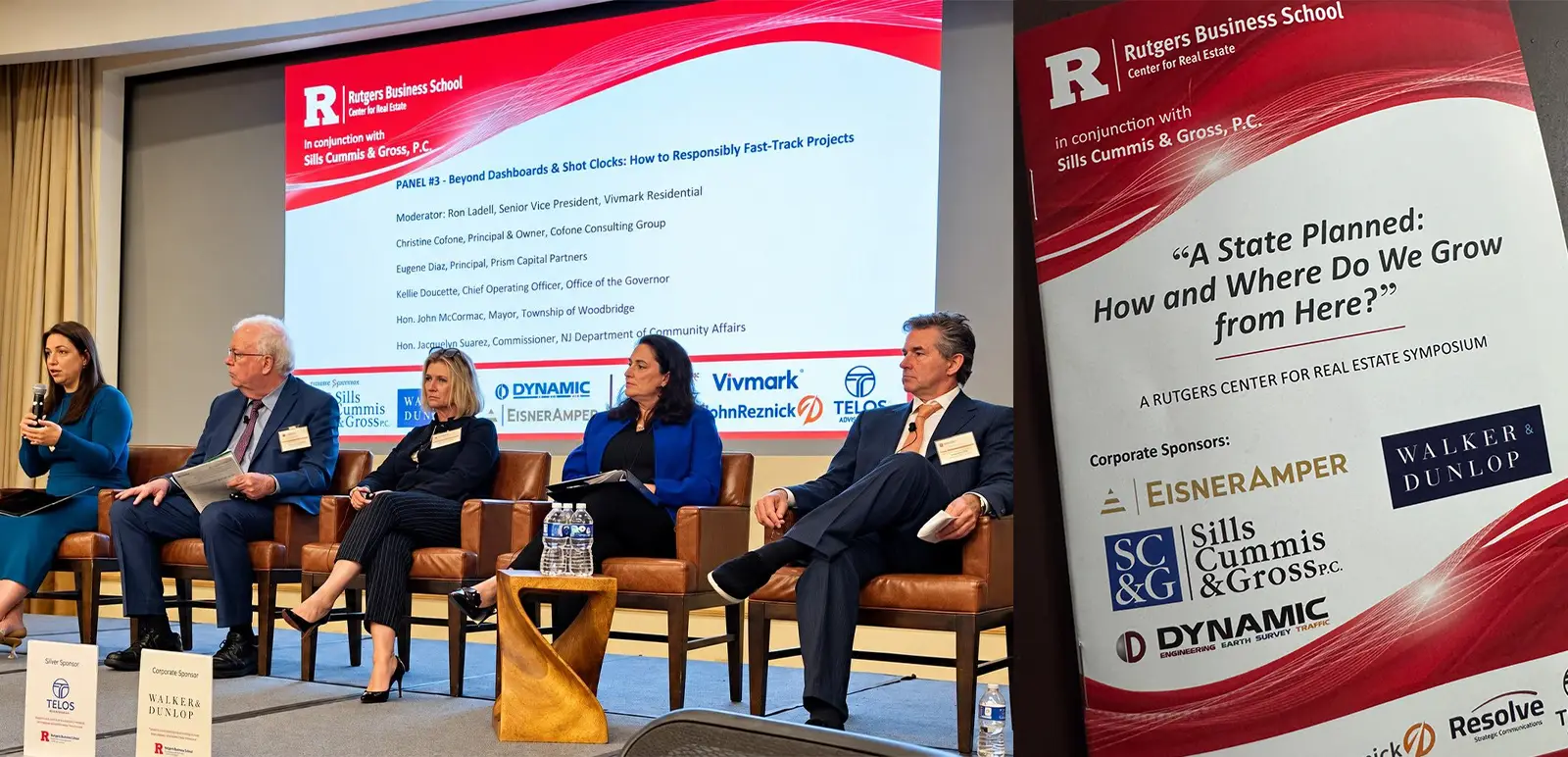
The Rutgers Center for Real Estate Symposium, presented in partnership with Sills Cummis & Gross, brought together leaders from government, real estate development, infrastructure, environmental protection, and economic development to discuss how and where New Jersey should grow. The conversations were substantive, candid, and encouraging, particularly around redevelopment, permitting reform, public-private collaboration, and the need to position New Jersey more competitively.
Several themes emerged that deserve attention beyond the real estate industry.
Redevelopment Requires More Than Regulatory Reform
With approximately 9.55 million residents living within 7,355 square miles of land, New Jersey remains the most densely populated state in the country. Our future economic growth will depend significantly on how effectively we redevelop existing properties, modernize infrastructure, and create new opportunities within established communities.
The challenge is balancing growth with environmental responsibility, affordability, and regulatory predictability. Developers must navigate multiple agencies, municipal requirements, infrastructure limitations, and, in many cases, environmental remediation. These complexities create financial uncertainty that can discourage investment or extend development timelines.
During the symposium, New Jersey Department of Environmental Protection Commissioner Ed Potosnak discussed efforts to improve permitting efficiency through Operation FAST. Supported by $4.3 million in proposed FY2027 funding and 49 budgeted positions, the initiative focuses on expanding permitting capacity, modernizing technology, and reducing delays. Subsequent reporting indicated that 48 of the 49 positions had been filled and that the permitting backlog had declined by 72% over two months. This is the kind of measurable progress that should be recognized and communicated.
Woodbridge Mayor John McCormac reinforced the value of bringing decision-makers together early, establishing clear expectations, and addressing potential obstacles before they become costly delays. Why not establish a standard operating procedure around this collaborative approach and encourage other municipalities to adopt it?
Eugene Diaz, Principal of Prism Capital Partners, also raised concerns about inconsistencies in how municipalities define and review minor site plan applications. Greater standardization could improve predictability and accelerate appropriate approvals without compromising necessary oversight.
The message was clear: speed, reliability, affordability, effectiveness, and transparency matter. Regulatory reform and environmental stewardship should not be competing objectives. New Jersey needs both, supported by clear standards, accountability, and a culture that recognizes responsible development as an investment in our collective future.
Communicating the Economic Value of Development
One of my strongest takeaways was that we spend considerable time discussing the challenges associated with development but not nearly enough time explaining its economic value.
Developers assume substantial financial risk, often years before a project generates revenue. Communities, meanwhile, are understandably concerned about traffic, infrastructure, environmental impacts, and changes to neighborhood character. Without meaningful engagement, those concerns can overshadow the potential benefits of redevelopment.
Every significant redevelopment initiative should be supported by a clear, accessible economic impact narrative. Municipal officials, residents, and other stakeholders should understand the anticipated private investment, construction and permanent employment, potential tax revenue, environmental improvements, infrastructure commitments, and broader community benefits. Equally important, those projections must be credible, transparent, and accompanied by an explanation of the project’s potential costs and tradeoffs.
A $100 million redevelopment proposal is more meaningful when stakeholders understand how that investment translates into jobs, local purchasing, municipal revenue, and long-term economic activity. Economic impact studies, visual dashboards, project fact sheets, and community presentations can make complex information understandable and relevant. We should also communicate the cost of inaction, including the economic opportunities lost when properties remain vacant or underutilized.
Technology can streamline applications and improve access to information, but it cannot replace direct communication. The symposium repeatedly emphasized bringing municipal leaders, developers, engineers, environmental regulators, land-use attorneys, and community representatives into the conversation early. As marketers, we know that information alone does not change perceptions. People need context, relevance, and a reason to care. Trust is built through transparency, accountability, and authentic person-to-person engagement.
New Jersey Is a High-Value State, and the Numbers Support It
New Jersey’s economic value proposition is substantial. According to the U.S. Bureau of Economic Analysis, the state’s gross domestic product reached approximately $846 billion in 2024, an increase of 4.8% from the previous year in current dollars. The U.S. Census Bureau reports that approximately 44.5% of adults age 25 and older held at least a bachelor’s degree in 2024, while median household income reached $104,294, approximately 28% above the national median.
Our business community is equally impressive. According to the U.S. Small Business Administration’s 2025 State Small Business Profile, New Jersey is home to approximately 1.1 million small businesses, representing 99.7% of all businesses and employing approximately 1.9 million people. Between March 2023 and March 2024, the state recorded a net increase of 38,631 jobs, with small businesses accounting for 99.5% of that growth.
These figures reflect a remarkable concentration of economic activity, purchasing power, entrepreneurship, and educated talent within a relatively small geographic area. Our proximity to New York City and Philadelphia, extensive transportation infrastructure, research universities, healthcare institutions, life sciences companies, and logistics networks further strengthen the case for investment.
New Jersey may not compete on the lowest operating costs, but cost and value are not synonymous. Businesses evaluate access to markets, workforce capabilities, infrastructure, innovation, and long-term growth potential when determining where to invest. We should be making a more coordinated, evidence-based case for the return businesses can achieve by locating, expanding, and investing in New Jersey.
A Complete State. A Stronger Story to Tell.
The symposium’s final panel featured:
- Robert P. Antonicello, Grid Commercial Real Estate, LLC.
- John Boyd, The Boyd Company, Inc.
- Todd Fisher, Office of the New Jersey Governor
- Amy Herbold, Choose New Jersey, Inc.
- Steve Oroho, Former New Jersey Senator
- Evan Weiss, New Jersey Economic Development Authority
Their conversation shifted toward business attraction, investment, and New Jersey’s competitive positioning.
What I appreciated most was the collective recognition that New Jersey has extraordinary assets, but we need to become more intentional about how we communicate them. The discussion emphasized the importance of a predictable, responsive business environment, clear requirements, access to talent, and a compelling value proposition that differentiates New Jersey from competing markets.
Several phrases stood out: high-value, a complete state, open for business, fundamental change, and it’s showtime. Together, they reflected both the urgency of the moment and the opportunity to position New Jersey more confidently.
The panel also revisited the familiar campaign, “New Jersey & You: Perfect Together,” prompting a larger question about how we communicate our identity today. We are a state with access to major markets, a diverse economy, research institutions, a highly educated workforce, and exceptional geographic advantages. Those strengths should be part of a consistent, recognizable narrative rather than disconnected messages delivered by individual organizations.
Amy Herbold, President and CEO of Choose New Jersey, Inc., encouraged the audience to get out our pom-poms and celebrate the positive aspects of our state. As someone who is unapologetically enthusiastic about New Jersey, I appreciated the sentiment. More importantly, I believe it speaks to a much larger strategic opportunity.
New Jersey needs a coordinated, positivity-based brand strategy that extends beyond a tagline or advertising campaign. It should begin with research into existing perceptions among business decision-makers, investors, residents, and prospective talent, identify the attributes that differentiate our state, and establish measurable objectives.
The resulting strategy could equip state agencies, municipalities, chambers of commerce, developers, universities, and businesses with shared messaging, economic impact data, case studies, and creative resources. We should celebrate successful redevelopment, private investment, business expansion, workforce achievements, and communities demonstrating effective collaboration. We should also measure whether these efforts improve perceptions, generate investment inquiries, and strengthen business attraction and retention.
A positivity-based campaign does not require ignoring New Jersey’s challenges. Acknowledging those challenges while demonstrating measurable progress makes the message more credible. Strong brands are not built by declaring superiority; they are built by consistently demonstrating value.
Developing Our Future Workforce
Another encouraging announcement was Rutgers Business School’s newly approved Bachelor of Science in Real Estate, expanding the university’s existing real estate education offerings to both Newark and New Brunswick’s campuses. The program will prepare students for careers in development, investment, finance, and management, with the first students potentially graduating with the degree as early as May 2028.
Rutgers Center for Real Estate has awarded more than $2.4 million in scholarships to 375 students, demonstrating its commitment to preparing future industry leaders. Rutgers also reports that 56% of respondents to its Class of 2025 post-graduation survey participated in at least one internship, reinforcing the importance of experiential learning.
Ron Ladell, Executive Committee Chair of the Rutgers Center for Real Estate and Senior Vice President at Vivmark Residential, encouraged New Jersey businesses to support these efforts through internships, mentorships, scholarships, and direct engagement with students. His message reinforced an important connection between education and economic development: creating meaningful relationships between students and industry professionals strengthens our talent pipeline and gives emerging professionals compelling reasons to build their careers in New Jersey.
Turning Our Competitive Advantages Into Economic Growth
I left the Rutgers Real Estate Symposium encouraged by the expertise, collaboration, and commitment demonstrated by the leaders participating in these discussions. The path forward requires more efficient and predictable development processes, responsible environmental planning, investment in infrastructure, and continued workforce development. It also requires greater recognition of the role communication plays in building understanding and advancing economic priorities.
Through my work at Rizco, I have seen how effective brand strategy can influence perception, strengthen relationships, and create enterprise value. The same principles apply to economic development. When stakeholders understand the value proposition, see evidence supporting it, and have confidence in the people delivering it, they are better positioned to make informed investment decisions.
We have an opportunity to bring greater alignment to New Jersey’s economic development narrative, support that narrative with measurable evidence, and empower business and community leaders to become advocates for our state.
Amy Herbold’s call for more New Jersey cheerleaders resonated with me, as did Evan Weiss’s observation that our state’s balance sheet is full of assets that need to be leveraged. We have an extraordinary foundation of talent, infrastructure, innovation, and economic opportunity. Our challenge is not simply to celebrate those strengths, but to communicate their value through a unified, evidence-based narrative that builds confidence, attracts investment, and drives measurable economic growth.
New Jersey has an extraordinary story. We need to do a better job telling it, supporting it with facts, and ensuring that the people making investment decisions understand its value.
——
Debra Rizzi is President and Co-Founder of Rizco, a woman-owned, brand-led marketing agency headquartered in Wall, New Jersey. She serves on the Boards of Directors of the New Jersey Chamber of Commerce, Monmouth-Ocean Development Council, and NJ Ad Club, and is an Honorary Commander at Joint Base McGuire-Dix-Lakehurst.


